 how-to
How to Hide TV Wires in Wall: A 2026 Step-by-Step Guide
Table of Contents
- Tools, Materials, and Skills You Need Before You Start
- Step-by-Step: How to Hide TV Wires in Wall
- In-Wall Cable Management Kit: What to Look For and How to Use It
- TV Cord Cover Raceway: A Rental-Friendly Alternative
- NEC Electrical Code for In-Wall Cables: What You Must Know
- Wall-Specific Tips: Drywall, Brick, and Concrete
- DIY vs. Professional Installation: Which Is Right for You?
- Frequently Asked Questions
Last Updated: October 4, 2026
Tools, Materials, and Skills You Need Before You Start
Learning how to hide tv wires in wall starts with the right tools.
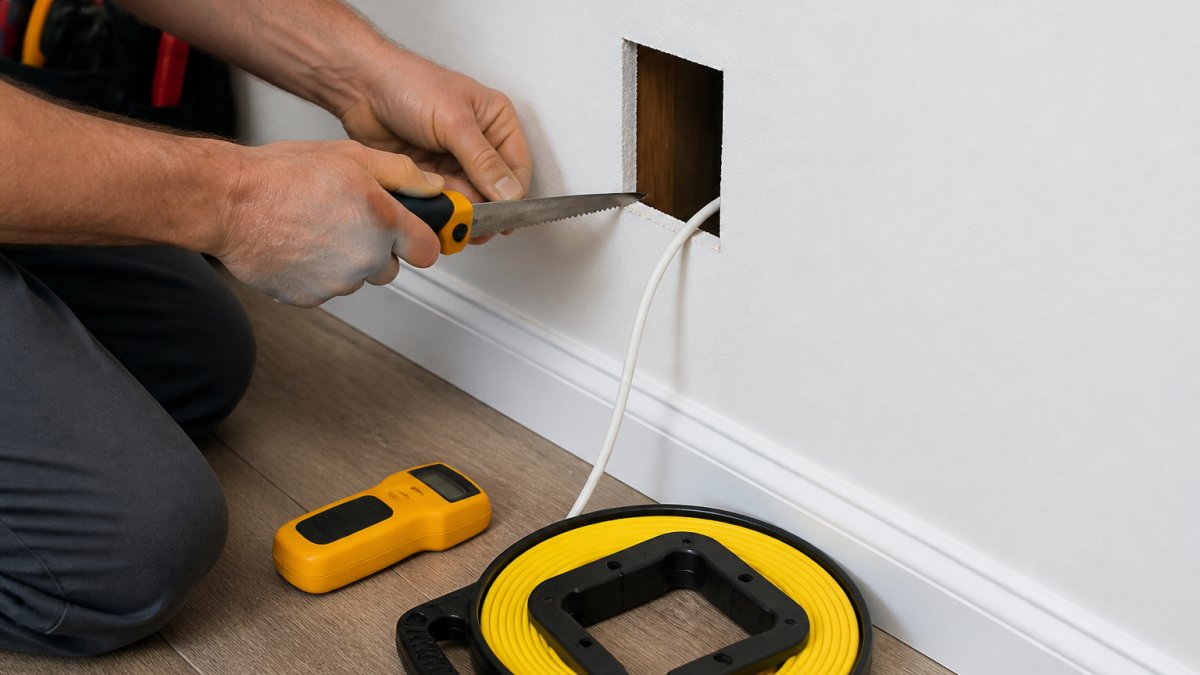
Essential Tools for Cutting and Fishing Cable
You do not need a truck full of gear, just the right tools.
- Stud finder to map framing and avoid drilling into a live wire
- Drywall saw for clean, small cuts around a wall plate
- Fish tape or a cable snake to pull wire through the cavity
Skipping the voltage tester is a common mistake. It costs a few dollars and ten seconds, and cutting blind into a live power cord turns a weekend job into an emergency.
Materials That Keep the Job Code-Compliant
The parts you buy decide whether the job is safe and legal. Standard extension cords are not rated for inside a wall. They overheat when air cannot reach them.
- In-wall rated HDMI and power cables (check the jacket rating)
- A cable pass-through kit with a wall plate
- A surface raceway if you would rather not open the wall at all
Step-by-Step: How to Hide TV Wires in Wall
The full process takes most homeowners a few hours for a single TV on drywall. Plan the route first, cut once, and fish the cables in one pass.
Step 1: Plan the Route and Mark the Wall
Decide where the TV hangs and where the equipment lives. Most people drop cables straight down to a media console or an outlet near the floor.
- Mark the TV mount height with painter's tape
- Mark the lower opening near your equipment or outlet
- Run the stud finder across both marks to check for framing and wires
If the marks land in different bays, move one until they line up.
Step 2: Cut the Drywall and Install a Cable Pass-Through
Cut the upper opening behind the TV and the lower opening at the equipment location, both just big enough for a low-voltage bracket.
- Score the drywall with a utility knife first to prevent tearing
- Cut with the drywall saw using light pressure
- Test-fit the bracket before you commit
Step 3: Fish the Cables and Finish the Wall Plates
Feed the fish tape from the top opening to the bottom, tape your cables to the end, and pull them through.
- Pull one cable at a time to avoid tangles
- Leave a foot of slack at each end
- Connect the wall plates and screw them down
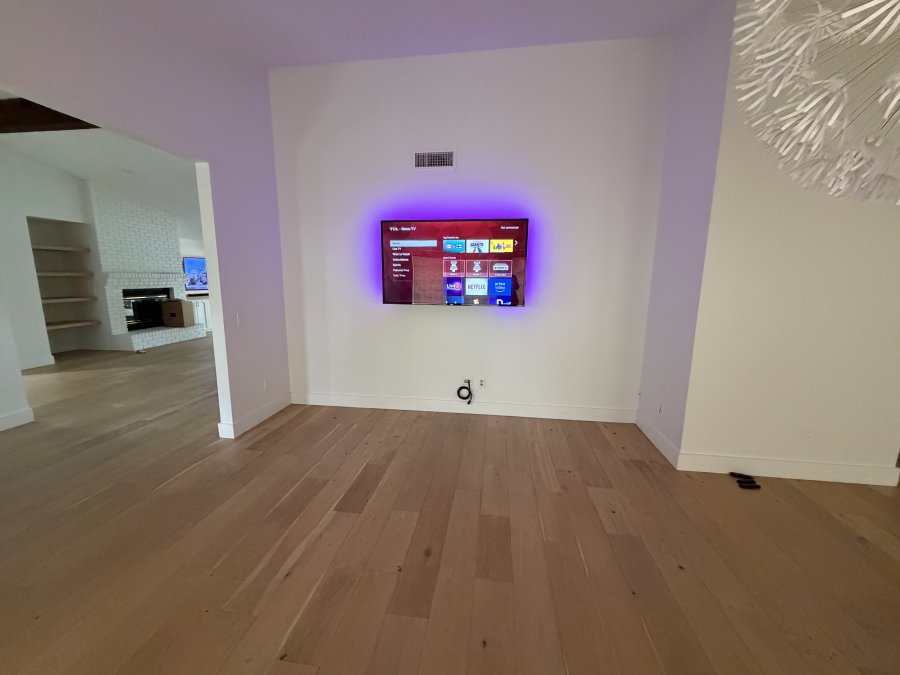
Expected result: a clean wall with no visible wires and a working signal at both ends.
In-Wall Cable Management Kit: What to Look For and How to Use It
An in-wall cable management kit is a packaged set of wall plates, brackets, and sometimes cables designed to move wires through a wall cavity cleanly. Most kits include two plates, mounting brackets, and screws. Some add in-wall rated HDMI and power cables.
What most guides miss is the rating. A kit is only as good as its cables. Look for these before you buy:
- Cables marked for in-wall use
- Metal or fire-rated plastic brackets
- A plate sized for your cable count
Installation is simple: mount both brackets, fish the cables, then snap the plates on. For a finished look without guesswork, this is the cleanest path.
TV Cord Cover Raceway: A Rental-Friendly Alternative
A tv cord cover raceway is a surface-mounted channel that hides cords without opening the wall. You stick or screw it on, lay the cords inside, and snap the cover shut. Many are paintable, so they blend in.
This is the right call for renters, brick walls, and anyone who does not want to cut drywall. Here is how the two approaches compare.
Method | Wall Damage | Best For | Skill Level |
|---|---|---|---|
In-wall kit | Cuts required | Owned homes, cleanest look | Intermediate |
Cord cover raceway | None to minimal | Rentals, brick, concrete | Beginner |
Cable sleeve | None | Bundling visible cords | Beginner |
NEC Electrical Code for In-Wall Cables: What You Must Know
The NEC electrical code for in-wall cables sets the rules for what can legally go inside a wall. You can review the standards through the NFPA overview of the National Electrical Code.
The short version for homeowners:
- Power cords must be rated for in-wall use
- Low-voltage cables like HDMI and coax follow separate rules
- Any penetration in a fire-rated wall needs proper sealing
Here is the part most people get wrong. Low-voltage cables are not the same as power cables. HDMI and speaker wire carry little current and are safer to run.
Wall-Specific Tips: Drywall, Brick, and Concrete
The wall material decides your method before you buy a single part. Drywall has a hollow cavity you can fish; brick, concrete block, and poured concrete do not, which eliminates the in-wall kit approach for most masonry homes.
Drywall: The Standard Case
Drywall is the only wall type where a true in-wall run is a weekend DIY job. The cavity is typically 3.5 inches deep on 2x4 framing and 5.5 inches on 2x6 framing, plenty of room for HDMI, coax, and low-voltage power kits.
- Use a stud finder that also detects AC wiring and metal, not just wood. Cheap magnetic stud finders only find nails and screws.
- Cut the top opening behind the TV and the bottom opening at the equipment location, keeping both inside the same stud bay.
- Score the drywall face with a utility knife before sawing. It prevents the paper from tearing past your cut line.
Brick: No Cavity, So Change the Plan
A brick veneer wall usually has a small air gap between the brick and the sheathing, but it is not a fishable cavity and is not rated for cable. You have three options:
- Surface raceway, a paintable channel screwed into the mortar joints, not the brick faces. Mortar is softer and easier to patch if you ever remove it.
- Existing chase, some homes have a conduit or a framed furring space behind the brick that you can use. Check before you assume there is nothing there.
- Through-the-wall to an interior closet, run the cables into an adjacent interior wall and drop them there. This keeps the brick face clean.
Drilling brick requires a carbide-tipped masonry bit and a hammer drill. Go slow, keep the bit cool, and never drill into a mortar joint you plan to leave exposed.
Concrete and Concrete Block: The Hardest Case
Poured concrete has no cavity at all. Concrete block (CMU) has hollow cores, but they are not predictably aligned and are full of rebar and grout in structural walls. Treat both as solid.
- Surface raceways and paintable cord covers are the practical answer for exposed concrete.
- If the concrete is furred out with framing and drywall on the interior side, you actually have a drywall job, the concrete is just the backstop.
- For a finished basement with a concrete wall, run the raceway along the top plate or the baseboard and paint it to match.
Renters: Non-Destructive Beats In-Wall Every Time
If you do not own the wall, do not cut it. A single unauthorized hole can cost you part of a security deposit, and patching brick or concrete to an invisible finish is not a weekend job.
- Adhesive-backed raceways and cord covers remove cleanly with a little heat from a hair dryer and a plastic scraper.
- Command-style strips and cable clips hold light low-voltage cables without screws.
- A cable management sleeve or a fabric wrap bundles visible cords into one clean line without touching the wall.
Match the method to the material before you buy anything. A drywall kit will not help you on brick, and a masonry bit will not help you on drywall.
DIY vs. Professional Installation: Which Is Right for You?
Most guides frame this as a skill question. It is really a risk question: the dividing line is not whether you can cut drywall, but whether the run involves line-voltage power, a fire-rated assembly, or a wall type you cannot easily repair.
The Real Dividing Line: Low Voltage vs. Line Voltage
Low-voltage cables, HDMI, coax, speaker wire, Ethernet, USB, carry small currents and are the DIY-friendly part of the job. Line-voltage power is different: a 120-volt branch circuit is governed by the National Electrical Code, and running an extension cord or standard power cord inside a wall is a code violation in most jurisdictions regardless of who does it.
The correct way to get power behind a wall-mounted TV is an in-wall rated power kit or a recessed media box wired to an existing circuit by a licensed electrician.
DIY Is Reasonable When All of These Are True
- The wall is standard drywall on wood or metal studs.
- The run is low-voltage only, or you are using a listed in-wall power kit that plugs into an existing receptacle.
- You have confirmed with a stud finder and a voltage tester that no live wiring crosses your path.
Call a Pro When Any of These Are True
- You need a new circuit, a new receptacle, or any work inside the electrical panel.
- The wall is brick, concrete, plaster, or a fire-rated assembly.
- You are running cable through fire blocking, insulation, or a chase you cannot see into.
The Cost of Getting It Wrong
A botched low-voltage run usually costs a drywall patch and an afternoon. A botched line-voltage run can cost far more: failed inspection at resale, an insurance claim denial if a fire is traced to unpermitted wiring, and in the worst case a shock or fire hazard inside a wall you cannot see. That asymmetry is the whole argument for hiring out the power side.
At All Around Technologies LLC, we handle TV mounting, home theater setups, and structured wiring for homes and businesses. We also install security cameras and smart home systems. If you want the cables hidden, the network clean, and the job done efficiently, that is what we do.
Frequently Asked Questions
Is it expensive to hide TV wires?
Costs vary based on your method. Professional installation adds labor, which depends on wall type, cable routing complexity, and your location. For a precise quote, contact a local installer. Many homeowners find that a raceway system may not look as clean as a fully concealed in-wall solution.
Can I run power cables inside a wall safely?
No, you cannot run standard power cords behind drywall. The NEC electrical code for in-wall cables requires that any electrical wiring inside a wall be rated for in-wall use, such as NM-B (Romex) cable installed by a licensed electrician. Using an extension cord or power strip inside a wall is a fire hazard and violates code. For safe concealment, install a new electrical outlet behind the TV or use a listed in-wall power relocation kit.
What kit can I use to hide TV wires behind the wall?
Look for an in-wall cable management kit that includes a cable pass-through wall plate, low-voltage mounting brackets, and fish tape. These kits are designed for HDMI, Ethernet, and speaker wires. For power, choose a kit with a built-in electrical outlet that meets NEC code, or hire a professional to add a receptacle. Always check that the kit is rated for in-wall use and matches your wall type.
How can I hide TV wires in a solid wall?
Solid walls like brick or concrete require a different approach. You cannot easily fish cables through them without surface-mounted raceways. Use a tv cord cover raceway that adheres to the wall or is screwed in, then paint it to match. For a cleaner look, hire a professional to cut a channel and patch it, but this is more invasive and costly. Always avoid running power cords inside solid walls without proper conduit and electrical work.
Hiding TV wires in the wall can give your TV installation a clean, professional look, but there’s more to it than simply cutting a hole in the drywall and pulling cables through. The type of wall, the cables being installed, and the location of electrical wiring all matter.
For homeowners in Royse City, Rockwall, Greenville, Fate, and surrounding DFW communities, All Around Technologies LLC provides professional TV mounting and hidden-wire installation designed to keep your entertainment setup clean and organized.
In this guide, we’ll cover the tools and materials commonly used to hide TV wires, how in-wall cable routing works, alternatives such as cord raceways, and when it makes sense to bring in a professional.
If you’d rather have the installation handled for you, All Around Technologies LLC can help with TV mounting, hidden-wire installation, home audio, networking, and related technology services.